







*By . Jerome Aduojo Agi PHD.
*INTRODUCTION*
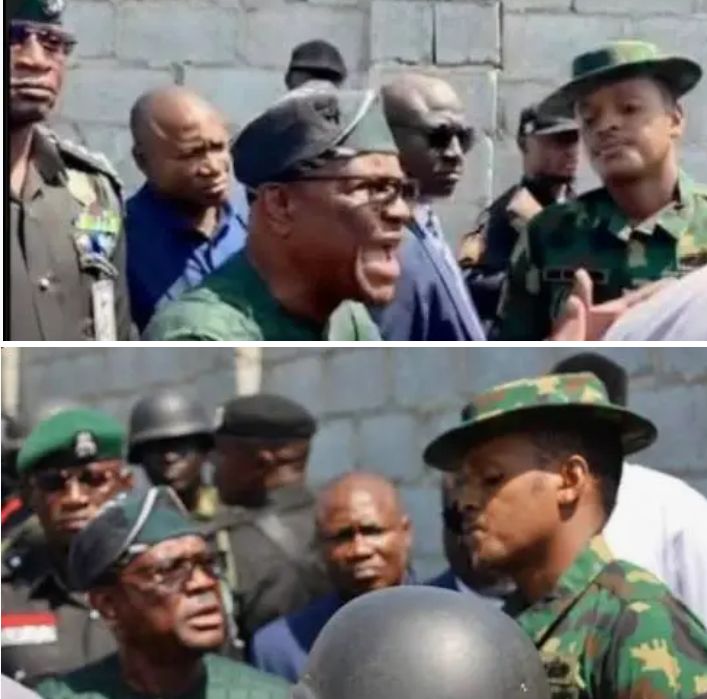
The relationship between civilian authorities and the military institution in any democratic society is delicate and must be governed by mutual respect, discipline, and adherence to the rule of law. In recent times, reports of a serving Minister of the Federal Republic of Nigeria engaging in a verbal confrontation with a military officer—who was under lawful orders to protect and defend a property—have generated national concern. The Minister’s action in allegedly calling the officer a “fool” and attempting to force entry into the restricted premises raises fundamental questions about constitutional order, respect for state institutions, and the integrity of Nigeria’s civil-military relations.
This incident, beyond its immediate drama, has profound implications for the military hierarchy, the credibility of the government, and the authority of the Commander-in-Chief. It also challenges the very fabric of Nigeria’s constitutional democracy, which is anchored on separation of powers, accountability, and respect for due process.
*THE MILITARY INSTITUTION AND OBEDIENCE TO LAWFUL ORDERS*
The Armed Forces of Nigeria are constitutionally empowered under Section 217 of the 1999 Constitution (as amended) to defend the nation’s territorial integrity, protect lives and property, and assist civil authorities when called upon. Military officers are trained to act strictly under lawful orders issued through their chain of command. Disobedience to such orders constitutes a serious breach of military discipline, which can attract grave consequences, including court-martial.
In the incident in question, the military officer reportedly maintained discipline, decorum, and firmness despite provocation. By refusing to be intimidated or to breach his standing orders, the officer upheld the sanctity of the military code and demonstrated loyalty not to an individual, but to the Constitution of the Federal Republic of Nigeria. His restraint is commendable and represents the professionalism expected of the armed forces in a democratic setting.
*IMPLICATIONS OF THE MINISTER ’S CONDUCT*
1. *INSTITUTIONAL IMPLICATIONS*
When a serving Minister—a high-ranking government official—engages in public confrontation with a uniformed officer on lawful duty, it undermines the sanctity of public institutions. The military thrives on hierarchy, respect, and discipline. Any attempt by a political appointee to belittle or override that structure sends a dangerous signal that political power can be abused to subvert institutional order.
Such acts, if left unchecked, erode public confidence in the government’s ability to enforce discipline and respect across all arms of governance.
2. *IMPLICATIONS FOR THE MILITARY HIERARCHY*
The military operates on a rigid chain of command. If a Minister can insult or countermand an officer’s lawful duty without consequences, it weakens morale and authority within the ranks. Subordinates may begin to question the value of loyalty and obedience if political figures can interfere with operational duties. It also places superior officers in a difficult position, torn between defending their subordinates and avoiding political backlash.
3. *IMPLICATIONS FOR THE COMMANDER-IN-CHIEF*
The President of the Federal Republic of Nigeria, as Commander-in-Chief of the Armed Forces, bears ultimate responsibility for maintaining military discipline and morale. When a Minister publicly undermines an officer, it indirectly challenges the President’s authority. A failure to address such misconduct can be perceived as tacit approval, thereby weakening the Commander-in-Chief’s moral and constitutional standing as the custodian of order and justice.
*CONSTITUTIONAL AND LEGAL IMPLICATIONS*
Under the Code of Conduct for Public Officers (Fifth Schedule, Constitution of the Federal Republic of Nigeria), every public officer must act in a manner that upholds the dignity and integrity of their office. Verbal abuse of a uniformed officer, obstruction of lawful duty, or attempting to exert unauthorized power constitutes abuse of office.
The Criminal Code Act (Section 124) also criminalizes obstructing or insulting a public officer while performing lawful duties. Therefore, the Minister’s behavior may amount to a constitutional and ethical violation that could attract administrative sanctions or even legal consequences.
*WHAT MINISTER WIKE SHOULD HAVE DONE*
If the Minister believed that the officer’s actions or the security arrangement around the property violated the law, the proper course of action would have been to:
1. Seek clarification through proper channels—by contacting the Defence Headquarters or the Chief of Naval Staff.
2. Report perceived misconduct to the National Security Adviser (NSA) or the Office of the Commander-in-Chief for administrative review.
3. Refrain from direct confrontation with personnel on duty, especially when security orders are involved.
4. Document and escalate the matter formally through written communication, allowing lawful investigation and resolution.
*EXPECTED ROLES OF THE POLICE, DSS, AND MINISTER ’S SECURITY DETAILS*
-The Nigeria Police Force and the Department of State Services (DSS) are primarily responsible for providing protection to public officials and maintaining law and order. In such situations:
-The Minister’s security aides should have de-escalated the situation, not joined in the confrontation.
-The Police should have ensured mutual respect between the parties and sought clarification without violating the officer’s orders.
-The DSS, as intelligence personnel, should have observed and reported the incident through official channels rather than allowing public disorder.
-Their role is to protect, not provoke; to mediate, not escalate.
*RECOMMENDATIONS*
1. *Presidential Intervention:*
The President and Commander-in-Chief should order an independent inquiry into the incident. If the facts are confirmed, disciplinary measures should be taken to reaffirm the supremacy of the Constitution and the dignity of the Armed Forces.
2. *Public Apology and Sanction:*
The Minister should tender an unreserved apology to the military institution and the concerned officer. Administrative sanctions may also be necessary to deter future misconduct.
3. *Reinforcement of Civil-Military Education:*
Ministers, governors, and senior officials should undergo periodic civil-military relations and protocol training to understand boundaries and institutional respect.
4. *Strengthening Accountability Mechanisms:*
The Code of Conduct Bureau (CCB) and relevant oversight bodies should enforce disciplinary provisions for public office holders who abuse authority.
5. *Commendation for the Officer:*
The officer’s conduct should be officially recognized as a model of discipline and professionalism under provocation.
*CONCLUSION*
Democracy thrives where the rule of law prevails over the rule of personality. The incident between a serving Minister and a military officer is more than a personal altercation—it is a test of Nigeria’s institutional maturity. Public officers, irrespective of rank or portfolio, must remember that authority in a democracy is derived from the Constitution, not from arrogance or power play.
The Minister’s action, if not addressed decisively, could erode respect for the military and embolden lawlessness among other officials. The President, as Commander-in-Chief, must therefore act swiftly to uphold discipline, reaffirm the military’s integrity, and send a clear message that no one is above the law.