




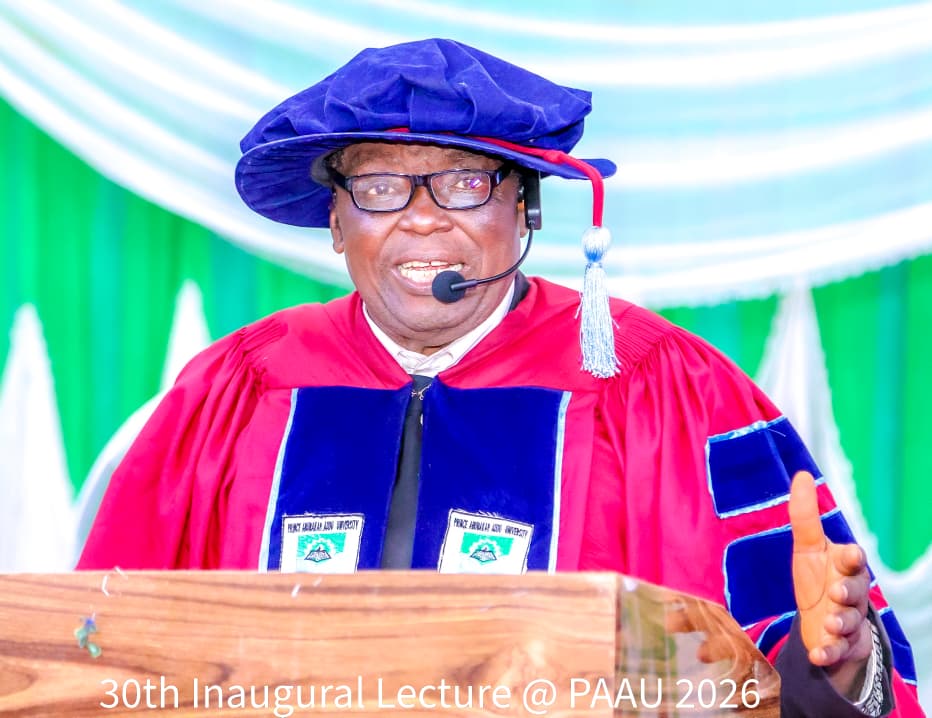
Professor Lawrence Achimugu, Dean of the Faculty of Education at Prince Abubakar Audu University (PAAU), Anyigba, has called for improved teacher welfare, increased education funding and effective implementation of innovative teaching methods to strengthen science education in Nigeria.
Achimugu made the call on Tuesday, October 20, 2026, while delivering the university’s 30th Inaugural Lecture titled, “Monkey De Work, Baboon De Chop: The Dark Shadow over Innovative Teaching Methods in Science Education.”
He said science education was essential to national development, as it equips learners with the critical thinking, problem-solving and practical skills required to drive innovation in medicine, engineering, agriculture, technology and other sectors.
The professor stressed that science teaching should go beyond memorising facts to encourage inquiry, experimentation, creativity and the practical application of scientific knowledge.
He identified emerging approaches in science education to include inquiry-based, problem-based and project-based learning, STEM and STEAM education, digital and virtual laboratories, artificial intelligence-supported learning, flipped classrooms, blended learning and the enriched lecture method.
According to him, these approaches promote active participation, collaboration and self-directed learning, preparing students to address real-world challenges in an increasingly technology-driven society.
However, he lamented that inadequate funding, poor infrastructure, insufficient instructional materials, overcrowded classrooms, limited teacher training and weak implementation of education policies continue to hinder the adoption of innovative teaching methods in Nigeria.
Explaining the title of his lecture, Achimugu said the expression “Monkey De Work, Baboon De Chop” symbolised a system in which teachers are expected to invest additional effort in improving teaching and learning without commensurate remuneration, recognition or institutional support.
He warned that such conditions could undermine teachers’ morale, professional commitment and willingness to adopt innovative instructional approaches, leaving many educational innovations at the level of policy and theory rather than effective classroom practice.
He noted that the absence of functional laboratories, modern equipment, reliable electricity, internet connectivity and digital facilities particularly disadvantaged schools in rural and underserved communities.
The don added that overcrowded classrooms made it difficult for teachers to provide individual attention, monitor students’ progress and implement learner-centred approaches effectively.
On teacher preparation, he stressed the need for continuous professional development and adequate training to equip educators with the skills and confidence required to integrate modern instructional strategies and digital technologies into their lessons.
Achimugu also disclosed that findings presented in his lecture indicated limited awareness and underutilisation of several recommended innovative teaching methods among science teachers, underscoring the need for sustained training and stronger institutional support.
Drawing from more than 42 years of teaching experience across primary, secondary and tertiary institutions, he emphasised that the quality of science education was closely linked to a nation’s capacity to develop skilled professionals and respond to challenges in health, industrialisation, environmental sustainability and technological advancement.
To address the challenges, the professor called for a comprehensive review of teachers’ remuneration and welfare, proposing a new pay structure he described as a “Living Salary Scale.”
He urged governments at all levels to prioritise teachers’ welfare and provide incentives that would encourage commitment, professional growth and effective teaching.
He also advocated a comprehensive welfare package for teachers, particularly science educators, to include annual leave allowance, furniture allowance, disturbance allowance for transferred teachers, vehicle refurbishment loans and housing loans.
Achimugu further called for increased funding for education, urging the Federal Government to work towards the budgetary allocation benchmarks he cited of 26 per cent of the annual budget and 15 per cent of Gross Domestic Product for education.
He stressed that improved funding must be matched by accountability, transparency, equity, good governance and effective implementation of approved budgets.
The inaugural lecturer also recommended the reintroduction of science allowance to encourage science teachers to undertake practical instruction and utilise the resources required for effective science education.
He urged teachers and university lecturers to adopt practical, student-centred approaches suited to their teaching environments, rather than pursue sophisticated innovations without adequate preparation or resources.
He further advocated the reintroduction and compulsory application of the Postgraduate Diploma in Education (PGDE) as a minimum teaching qualification for university lecturers to strengthen their pedagogical competence.
Achimugu maintained that improving science education required coordinated reforms covering teacher welfare, infrastructure, instructional resources, curriculum and examination systems, professional development and institutional support.
He said educational innovations could only deliver meaningful results when teachers were adequately trained, properly motivated and supported by policies that prioritised effective teaching and learning.
Earlier, the Vice-Chancellor of PAAU, Professor Salisu Ogbo Usman, described the lecture as a reaffirmation of the university’s commitment to scholarship, intellectual engagement and the application of research to societal development.
Usman said the topic was timely, noting that science education played a central role in a society’s ability to innovate, solve problems and compete in a knowledge-driven world.
He stressed that effective science teaching must go beyond the transmission of facts and memorisation to incorporate experimentation, laboratory practice, inquiry and appropriate technology to develop students’ creativity, curiosity and problem-solving abilities.
The vice-chancellor noted that the quality of science education had far-reaching implications for national development, particularly in agriculture, healthcare, engineering, technology and industrial growth.
He congratulated Achimugu on the academic milestone and commended his contributions to teaching, research, mentorship and educational leadership.
Usman also acknowledged the Chairman of the Inaugural Lecture Committee, Professor S. S. Arogba, and other committee members for their efforts in organising the event.
The lecture attracted members of the university community and other invited guests, who gathered to celebrate the academic milestone and reflect on ways to strengthen science education through effective teaching methods.