







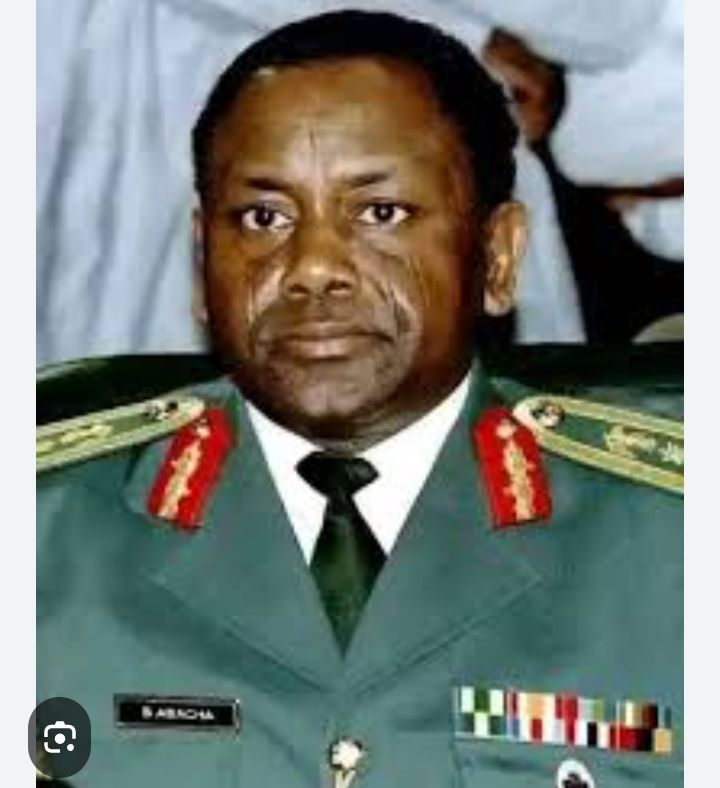
*GENERAL SANI ABACHA, GCFR (1943–1998) :*
*A REASSESSMENT OF A CONTROVERSIAL STATESMAN TWENTY-EIGHT YEARS AFTER*
*Compiled & Written By Jerome Aduojo Agi, Ph.D.*
*INTRODUCTION.*
On June 8, 1998, Nigeria was shocked by the sudden death of General Sani Abacha, GCFR, the nation’s Head of State from November 1993 until June 1998. More than two decades later, few Nigerian leaders continue to evoke such sharply divided opinions.
To some, General Abacha remains the embodiment of military authoritarianism, political repression, and the limitations of military rule. To others, he was a disciplined, patriotic, and result-oriented leader whose economic policies, infrastructure initiatives, and uncompromising approach to national security left enduring marks on the Nigerian state.
As Nigeria reflects on the anniversary of his passing, history demands a more balanced assessment—one that neither ignores the criticisms of his regime nor overlooks the legacies that continue to shape modern Nigeria.
The true question may not be whether General Abacha was a hero or a villain, but whether he was one of the most misunderstood leaders in Nigeria’s modern history.
*LEADERSHIP STYLE : ROUND PEGS IN ROUND HOLES .*
Supporters of General Abacha often argue that one of his strongest leadership attributes was his ability to identify competent individuals and assign them responsibilities that matched their expertise.
As a military commander accustomed to results-oriented administration, he was reputed to have little patience for bureaucratic delays or ineffective leadership.
Many public institutions, government agencies, security organizations, and strategic national projects were entrusted to individuals who were given substantial authority and responsibility to achieve clearly defined objectives.
This management style reflected a leadership philosophy often summarized as placing “round pegs in round holes”—matching people to positions based on competence, experience, and ability to deliver results.
While critics argued that the concentration of authority under military rule reduced institutional checks and balances, admirers contend that such decisiveness enabled faster execution of projects, stronger policy coordination, and more efficient implementation of government programmes.
The debate continues among historians and policy analysts, but there is little doubt that General Abacha preferred a command-and-performance model of governance in which appointees were expected to deliver measurable outcomes rather than merely occupy offices.
A Legacy That Continues to Generate Debate
Twenty-eight years after his death, General Sani Abacha remains one of the most debated figures in Nigerian history.
His admirers point to Economic Stability, State Creation, Infrastructure expansion, Strategic National Planning, Housing Development, Sports Achievements, Security Consciousness, and Administrative Efficiency.
His critics emphasize the democratic limitations, human rights concerns, and political controversies associated with military rule.
Yet even many of his critics acknowledge that some of the institutions, projects, and administrative structures established during his tenure continue to influence Nigeria’s development trajectory today.
Perhaps that is why the discussion about General Sani Abacha has never truly ended. His legacy remains a subject of national reflection, historical reassessment, and continuing debate among Nigerians at home and abroad.
*THE NO-NONSENSE GENERAL .*
General Sani Abacha was known for few words but decisive action. Unlike many politicians who governed through speeches, he governed through directives and implementation.
He projected the image of a focused military commander who believed strongly in discipline, national unity, territorial integrity, and governmental authority.
One statement often attributed to him captures his philosophy of leadership :
*”Any insurgency or crisis that lasts beyond 48 hours without being resolved suggests government complicity.”*
Whether apocryphal or authentic, the statement reflected his belief that government must never surrender its responsibility to protect citizens and maintain national order.
*ECONOMIC STABILITY AND FINANCIAL MANAGEMENT.*
One of the most frequently cited achievements of the Abacha administration was economic stabilization.
*During much of his tenure:*
– Inflation was reduced to single digits for several years.
– External debt obligations were managed aggressively.
– Foreign reserves increased significantly.
– The value of the Naira remained relatively stable.
– Government finances recorded notable surpluses compared with preceding years.
Many economists acknowledge that Nigeria experienced one of its most stable macroeconomic periods during the mid-1990s, despite international sanctions and diplomatic pressures. While debates continue regarding the sustainability of those policies, their immediate impact on inflation control and fiscal discipline remains widely recognized.
*VISION 2010 : PLANNING NIGERIA’S FUTURE .*
One of the most ambitious initiatives of the Abacha administration was Vision 2010.
The Vision 2010 Committee brought together distinguished Nigerians from various sectors to develop a long-term framework for National Development.
*The initiative sought to :*
– Diversify the economy.
– Reduce dependence on crude oil.
– Improve infrastructure.
– Promote industrialization.
– Strengthen governance institutions.
– Position Nigeria among the world’s leading economies.
Though subsequent governments modified aspects of the initiative, many later development plans—including Vision 20 : 2020—drew inspiration from the strategic planning culture introduced during this period.
*CREATION OF STATES AND LOCAL GOVERNMENTS*
Among General Abacha’s most enduring constitutional legacies was the creation of six additional states in 1996:
– Bayelsa State
– Ebonyi State
– Ekiti State
– Gombe State
– Nasarawa State
– Zamfara State
This increased Nigeria’s states from 30 to the present 36.
The creation of Bayelsa State was particularly significant because it gave greater administrative recognition to the Niger Delta region where Nigeria’s first commercial crude oil discoveries originated.
Similarly, the creation of Gombe State enhanced representation for communities in the North-East.
The establishment of Osun State earlier and subsequent political balancing efforts under military administrations contributed to reducing historical tensions among major Yoruba traditional institutions, including the revered stools of the Alaafin of Oyo and the Ooni of Ife. *Creation of Nasarawa State:* Bringing Development Closer to the Federal Capital Territory.
Among the six states created by General Sani Abacha in 1996, the creation of Nasarawa State from the old Plateau State remains one of the most strategic.
The creation of Nasarawa State brought government closer to the people, enhanced political representation, accelerated grassroots development, and provided a distinct identity for the diverse ethnic nationalities within the area.
Perhaps more significantly, Nasarawa emerged as the closest state to the Federal Capital Territory (FCT), Abuja, creating enormous opportunities for economic expansion, population growth, investment, agriculture, housing development, and industrialization.
Today, Nasarawa State serves as a major economic partner to the FCT, providing land for expansion, agricultural products, mineral resources, and residential accommodation for thousands of workers and businesses connected to Abuja.
Many analysts regard the creation of Nasarawa State as one of the most strategic administrative decisions of the period because of its long-term contribution to the growth and sustainability of the Federal Capital Region.
General Abacha’s administration also created numerous Local Government Areas across the federation, including areas that enhanced grassroots governance and representation. Communities such as Omala Local Government Area in Kogi State benefited from the broader policy of strengthening local administration and bringing governance closer to the people.
*INSTITUTIONALIZATION OF THE SIX GEOPOLITICAL ZONES.*
Perhaps one of the most important but often overlooked legacies of the Abacha era was the formal recognition and administrative use of Nigeria’s six geopolitical zones.
The six zones are:
– North Central
– North East
– North West
– South East
– South South
– South West
Today, virtually every major political, economic, educational, and governmental arrangement in Nigeria is structured around these zones.
The geopolitical framework has become one of the strongest instruments for balancing representation, appointments, resource allocation, and national integration.
*INFRASTRUCTURE AND NATIONAL DEVELOPMENT*
The Abacha administration pursued significant infrastructure expansion.
Projects associated with his era included :
– Expansion of Abuja’s infrastructure.
– Continued development of the Federal Capital Territory.
– Construction and advancement of the National Assembly Complex.
– Strengthening of federal highways.
– Investments in power infrastructure.
– Revitalization plans for railway modernization.
– Refineries turnaround maintenance programmes.
– Abuja witnessed accelerated development during this period, further consolidating its position as Nigeria’s Permanent Capital City.
*THE GWARINPA HOUSING ESTATE :* *A Model for Mass Housing Development.*
One of the most visible and enduring physical legacies associated with the Abacha era is the development of the Federal Housing Authority (FHA) Gwarinpa Housing Estate in Abuja.
Conceived as one of the largest and most ambitious housing projects in Nigeria and Africa, the Gwarinpa Estate demonstrated a bold vision for organized urban development, modern infrastructure, and mass housing delivery. Designed to accommodate thousands of residents within a planned environment, the estate featured road networks, drainage systems, schools, commercial centers, recreational facilities, and other essential urban amenities.
Over the years, Gwarinpa has become a benchmark for housing development in Nigeria. In real estate and urban planning circles, many housing projects across the country are often evaluated against what has become popularly known as the “Gwarinpa Standard.”
Even when newer estates fail to meet the infrastructure, planning, and environmental standards established by Gwarinpa, the estate remains a reference point for what a well-conceived government housing project can achieve.
For many Nigerians, Gwarinpa stands as evidence that with vision, planning, and political will, government can successfully deliver large-scale housing solutions capable of transforming urban living.
*TELECOMMUNICATIONS REVOLUTION: GSM FOUNDATIONS* .
Although GSM services were officially launched under the civilian administration that followed, many analysts recognize that policy groundwork, regulatory restructuring, and preparatory reforms undertaken in the late military era helped create conditions that enabled Nigeria’s telecommunications revolution.
The GSM revolution would later transform Nigeria into one of Africa’s largest telecommunications markets.
*SPORTS DEVELOPMENT AND NATIONAL PRIDE.*
The Abacha era coincided with some of Nigeria’s greatest sporting achievements.
*USA ’94 WORLD CUP*
Nigeria made a historic debut at the 1994 FIFA World Cup in the United States, capturing global attention with exciting performances.
*ATLANTA 1996 OLYMPIC GOLD*
Nigeria won Africa’s first Olympic football gold medal at the 1996 Olympic Games in Atlanta.
The Super Eagles defeated powerhouse nations and secured a historic victory that remains one of the greatest achievements in African football history.
These accomplishments elevated Nigeria’s image internationally and inspired an entire generation of young Africans.
*NATIONAL STADIUM AND SPORTS INFRASTRUCTURE* .
General Abacha’s administration laid foundations for major sports infrastructure initiatives, including plans and developments that eventually contributed to the realization of modern sporting facilities in Abuja.
Preparations associated with Nigeria’s hosting ambitions for major sporting events also stimulated investments in stadium upgrades nationwide.
*FEAP AND THE LEGACY OF HAJIYA MARYAM ABACHA* .
No assessment of the Abacha years is complete without acknowledging the contributions of the First Lady, Mrs. Maryam Abacha.
Through the Family Economic Advancement Programme (FEAP), efforts were made to :
– Promote poverty alleviation.
– Support women empowerment.
– Encourage small-scale enterprises.
– Expand rural economic participation.
The Family Support Programme also contributed to healthcare and social welfare initiatives.
Many observers associate these efforts with the eventual establishment of what became the National Hospital Abuja.
*AGRICULTURE AND RURAL DEVELOPMENT* .
*The administration promoted:*
– Agricultural self-sufficiency.
– Rural development.
– Expansion of agricultural credit.
– Strengthening of agricultural financing institutions.
These policies sought to reduce food imports and encourage local production.
*NATIONAL SECURITY AND REGIONAL STABILITY* .
General Abacha maintained a firm approach toward national security.
Nigeria remained a dominant force within ECOWAS peacekeeping operations and played important roles in regional conflict management, particularly in West Africa.
The Nigerian military continued to serve as a stabilizing force in peace operations in Liberia and Sierra Leone, reinforcing Nigeria’s status as Africa’s regional power.
His administration placed strong emphasis on:
– Territorial integrity.
– National sovereignty.
– Internal security.
– Military readiness.
– Education and University Development
Several accounts from individuals who served in public institutions during the period recall extensive infrastructure projects in federal universities.
At the University of Abuja, significant expansion programmes were reportedly underway in the late 1990s, with ambitious plans aimed at transforming the institution into a world-class university.
Many who were present during that period maintain that further major announcements and development initiatives were expected around the institution’s convocation activities shortly before the General’s sudden death.
*THE CRITICISMS AND CONTROVERSIES*
A balanced assessment must also acknowledge the criticisms associated with the Abacha regime.
His administration faced allegations and criticisms regarding:
– Political repression.
– Restrictions on civil liberties.
– Detention of political opponents.
– Human rights concerns.
– Press censorship.
– International isolation.
– Allegations of large-scale corruption and recovery of funds linked to members of the regime after his death.
These issues continue to influence global perceptions of his government and remain central to scholarly debates about his legacy.
It is also possible that some actions undertaken by powerful officials, security operatives, and political associates during the era became permanently associated with the Head of State himself.
History continues to debate where responsibility should be assigned between the leader and those acting under his authority.
*CONCLUSION : THE VERDICT OF HISTORY*
General Sani Abacha remains one of the most consequential figures in Nigeria’s history.
His administration left behind enduring structures, including :
– The six geopolitical zones.
– Six additional states.
– Economic stabilization policies.
– Vision 2010 strategic planning.
– Infrastructure development and FHA Gwarinpa, Abuja Housing Estate landmark of Housing in Nigeria .
– Strengthened national security architecture.
– Expanded federal institutions.
– Support for sports excellence and Victories .
– Programmes aimed at poverty alleviation and rural development.
Yet his era also remains associated with the excesses commonly attributed to military rule and the democratic deficits inherent in military governance.
History rarely presents leaders as entirely good or entirely bad.
As Nigeria remembers General Sani Abacha on the anniversary of his death, perhaps the most balanced conclusion is that he was a complex leader—firm, patriotic, controversial, feared by some, admired by others, but unquestionably influential.
The final judgment of General Sani Abacha’s place in history will continue to evolve as future generations assess both his achievements and his shortcomings.
Time, as always, remains the ultimate judge.