








announces November 1 inauguration of ward, local government structures
The Win With Tinubu (WWT) Grassroots Mobilisation Programme in Kogi State has announced plans to inaugurate its local government and ward executive structures simultaneously across the state’s 239 electoral wards on Sunday, November 1, 2026, as part of efforts to strengthen grassroots political engagement ahead of the 2027 general elections.
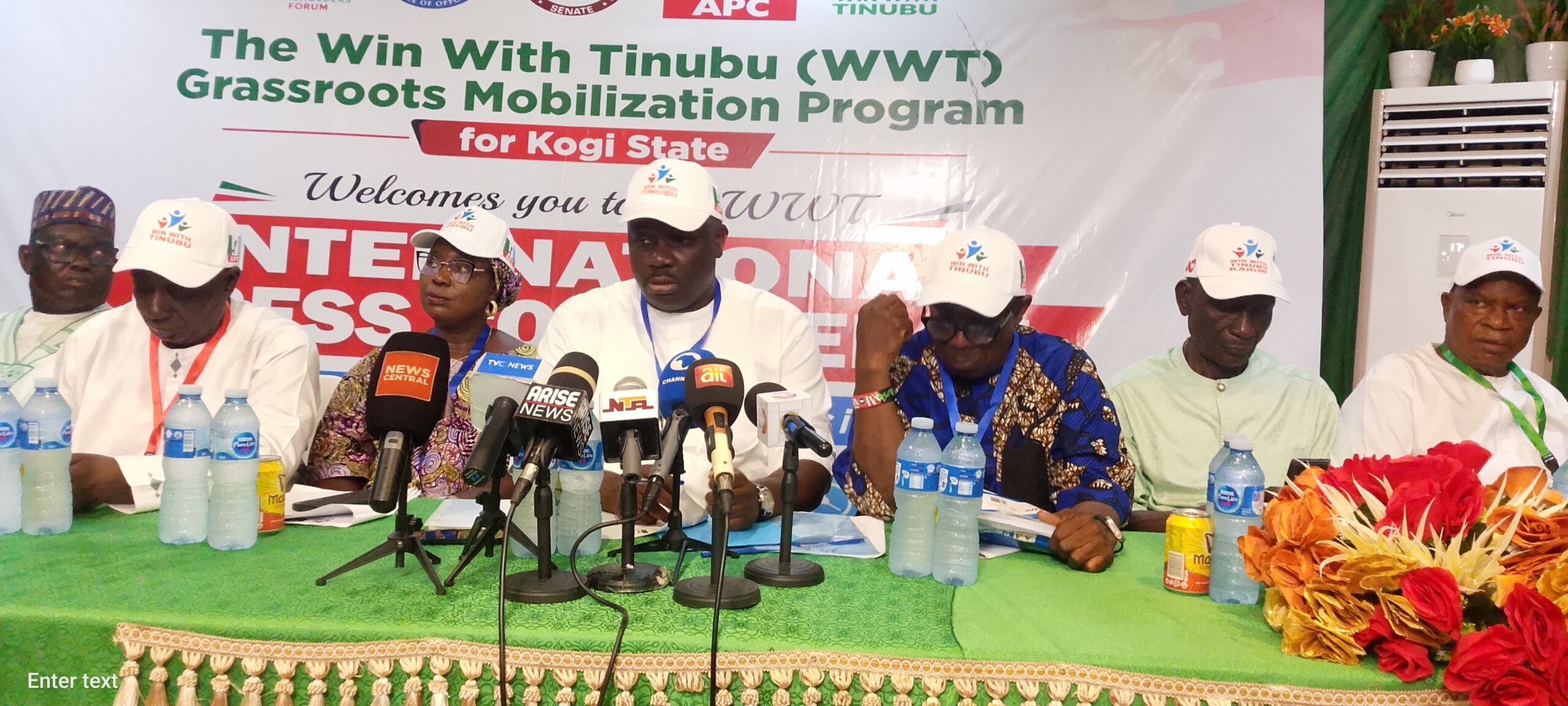
The State Programme Coordinator, Hon. Sani Phillips, disclosed this during a press conference on Thursday, where he outlined the programme’s transition from constituency-wide town hall meetings to a decentralised, ward-based mobilisation network.
Phillips said the initiative, themed “Re-engineering Grassroots Politics in Kogi State,” was designed to establish a coordinated grassroots structure to mobilise support for the re-election of President Bola Ahmed Tinubu and other candidates of the All Progressives Congress (APC) in the state.
He explained that the planned inauguration represented the second phase of the programme, following the completion of town hall meetings across the state’s federal constituencies.
According to him, the initial engagements provided platforms for political dialogue, stakeholder interaction and discussions on federal government policies under the Renewed Hope Agenda, while helping the programme develop strategies for expanding its grassroots presence.
Phillips acknowledged the contributions of key political stakeholders, particularly Senator Sunday Steve Karimi, representing Kogi West Senatorial District and Chairman of WWT, and Senator Jibrin Isah, popularly known as Echocho, representing Kogi East Senatorial District and Co-Chairman of the programme.
He said their support had helped lay the foundation for a broader mobilisation framework across the state.
“Grassroots mobilisation is fundamental to winning elections, and communities represent the majority of voters whose decisions ultimately shape electoral outcomes,” Phillips said, stressing that sustainable political engagement must go beyond periodic meetings to establish functional structures within communities.
He added that the second phase would connect all 239 electoral wards through a coordinated network of executives, volunteers and political stakeholders, with clearly defined responsibilities and communication channels.
The coordinator identified five key areas of focus for the new phase: ward-level coordination, policy communication, community engagement, volunteer mobilisation, and monitoring, reporting and accountability.
On ward-level coordination, he said the programme would establish clear leadership arrangements and operational responsibilities, enabling ward executives to work with their local government counterparts and maintain effective communication with the state leadership.
Regarding policy communication, Phillips said the initiative would promote factual, verifiable and accessible information about federal government policies and programmes, while encouraging constructive engagement with citizens on issues affecting their communities.
He emphasised that credible political communication must be based on verifiable information and presented responsibly to enable citizens to make informed decisions.
On community engagement, he said the structures would serve not only as channels for communicating political messages but also as platforms for listening to residents, identifying local priorities and documenting concerns from the grassroots.
Phillips further stated that the programme would encourage voluntary participation in political activities, insisting that its mobilisation strategy would be based on persuasion, trust and peaceful engagement rather than intimidation or coercion.
“There will be no place for intimidation, coercion, or inducement,” he declared, adding that sustainable political support was best achieved through consistent engagement and respect for democratic rights.
He also said the programme would introduce stronger monitoring and reporting mechanisms to track activities, assess progress, identify operational challenges and improve coordination across its structures.
Phillips clarified that the Win With Tinubu Grassroots Mobilisation Programme was not a campaign council but a dedicated political mobilisation initiative designed to build support for President Tinubu’s re-election and APC candidates contesting National Assembly seats in Kogi State.
He explained that the programme’s operational model would grow from the wards through local governments to the state level, reflecting its bottom-up approach to political organisation.
“The defining feature of the programme is its bottom-to-top approach. We believe meaningful political engagement requires direct contact with the people, organised community participation and functional structures capable of identifying local concerns,” he said.
Reaffirming the programme’s commitment to the 2027 general elections, Phillips said its activities would remain peaceful, voluntary and consistent with democratic principles.
He also welcomed media scrutiny, urging journalists to distinguish between announced plans, ongoing activities and verified results in their reportage.
The coordinator called on political stakeholders, supporters and volunteers across the state to support the planned rollout and work collectively towards the programme’s objectives.
He expressed confidence that the transition from constituency-level town hall meetings to a statewide ward network would strengthen grassroots coordination and improve sustained engagement with communities ahead of the elections.
The programme concluded its announcement with a call for unity among supporters, under the slogan: “You win, I win, we win—WinWin!”