









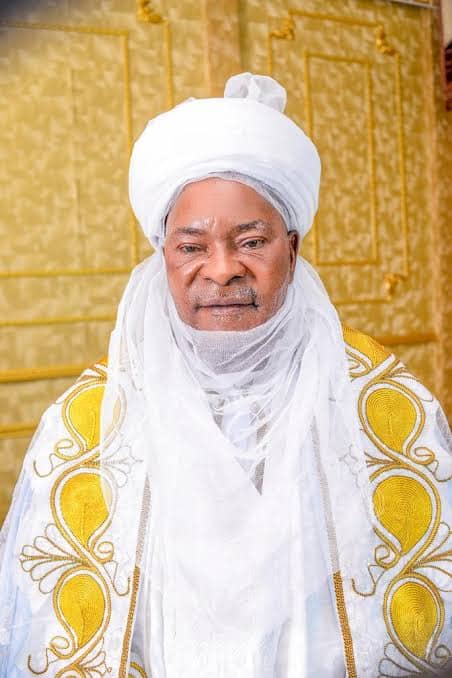
A Tribute on A Life of Enterprise, Providence and Public Service
By Amb. Valentine Opaluwa PHD.
There are lives that pass quietly through the corridors of time, leaving behind little more than a name. There are others whose journeys become woven into the history of a people, not because their lives were without controversy or complexity, but because they rose from ordinary beginnings to occupy extraordinary spaces in the story of their society.
The passing of His Excellency Alhaji Ibrahim Idris, former Governor of Kogi State, belongs to that second category.
His departure is a moment of profound sadness for his family, associates, friends, the people of Kogi State and, indeed, the entire Igala people. Death reminds us of the ancient equality of humanity: the powerful and the powerless, the rich and the poor, the celebrated and the obscure, all eventually stand before the same eternal gate. Yet, while death may close a life, it cannot erase the footprints that life has left upon the sands of history.
The measure of a man is therefore not only in the office he occupies, but also in the distance he travels to get there, the obstacles he crosses, the opportunities he recognises, the values he creates and the lives his journey touches.
I knew Alhaji Ibrahim Idris as a young boy in my teenage years in Anyigba. In those days, he was popularly known among us as “Ibrahim Furniture.” Whenever he came around to visit his relatives and his mother, many of us in the neighbourhood would throng around him. To us, he was already a figure of fascination.
There was something about his presence that attracted attention. He carried himself with the confidence of a man who had begun to understand his own possibilities. He was particularly known for his love of beautiful and flashy cars, a characteristic that had become associated with him from those early days.
But childhood memories sometimes acquire a different meaning when viewed from the distant window of history.
The man whom we knew simply as Ibrahim Furniture would one day become Governor of Kogi State.
And therein lies one of the profound mysteries of human existence: we often meet people before we know the destiny that time has written for them.
The boy who sees a man today cannot always see the governor he may become tomorrow. The neighbour who encounters an entrepreneur in his workshop may not know that history is quietly preparing a larger stage for him. Destiny rarely announces itself. It unfolds.
Ibrahim Idris’s story was, in many respects, the story of a self-made man.
He began early in life by learning the trade of carpentry and furniture making. Like many ambitious Nigerians whose dreams refused to be confined by geography, he ventured beyond his immediate environment in search of opportunity. His journey took him to places such as Onitsha, Minna and Sokoto, where he established himself through enterprise, perseverance and hard work.
He did not merely learn a trade; he transformed a trade into an enterprise.
From furniture making, he ventured into the hospitality business and built the Ibro Hotel in Sokoto. Later came the establishment of Ibro Hotel in Zone 5, Abuja, which, at the time, became one of the notable and sought-after hospitality establishments in the Federal Capital Territory because of its standard and facilities.
There is a philosophy hidden in this journey.
A man’s beginning does not necessarily determine his ending.
The carpenter can become a builder of institutions. The craftsman can become an entrepreneur. The businessman can become a statesman. The young man whom a neighbourhood remembers by a trade name can eventually be remembered by a constitutional office.
Life is sometimes a staircase whose higher steps cannot be seen from the lower ones.
By the time Ibrahim Idris entered partisan politics, he was already a successful and wealthy businessman. He therefore entered public life having demonstrated, through private enterprise, his capacity to build, organise, invest and create value.
His political emergence was itself remarkable.
In 2002–2003, at a time when Kogi politics was populated by established politicians, experienced public servants and influential political actors, Ibrahim Idris emerged, against considerable odds, as the gubernatorial candidate of the Peoples Democratic Party (PDP). His emergence followed a fiercely contested political process involving prominent figures, including Senator A. T. Ahmed, Senator Alex Usman Kadiri and other major political actors.
The political arena is rarely a place where dreams are handed out freely. It is a theatre of competition, alliances, expectations, disappointments and unexpected turns. For a businessman who had built his reputation outside the political establishment to emerge from such a contest was itself a significant chapter in his life’s journey.
He subsequently became Governor of Kogi State and served for two terms, leaving office after nine years in circumstances that were unusual in the political history of the state. His tenure became part of the political history of contemporary Kogi State and, as with the administrations of all public figures, will continue to attract different interpretations and assessments from citizens, scholars and political historians.
History, after all, is rarely written in a single voice.
But beyond the arguments of political history is the personal story of the man himself.
I had the privilege of meeting His Excellency on a few occasions. Each encounter left room for conversation beyond the ordinary courtesies of political life. He spoke about his journey into politics, how he became Governor and what he regarded as his modest contributions to the development of Kogi State.
One quality I observed in him was his appreciation of creativity.
He recognised value when he encountered it. He appreciated ideas and initiatives that could make a difference. In a world where originality is sometimes overlooked, the capacity to recognise and encourage creativity is itself a valuable quality.
His life also teaches us something about the mysterious relationship between work, opportunity and providence.
Hard work matters. Determination matters. Enterprise matters. But human beings also live within circumstances they do not completely control. There are moments when opportunity appears unexpectedly. There are doors that open at times we did not anticipate. There are encounters that alter the direction of a life.
This is where human effort meets providence.
One may prepare for an opportunity without knowing when it will arrive. And when it comes, the prepared mind recognises it.
Ibrahim Idris appears, in the story of his life, to have understood this intersection between preparation and opportunity.
From being called Ibrahim Furniture, he became an entrepreneur, a hospitality investor, a political actor and eventually the Governor of Kogi State.
That journey is worthy of remembrance because it speaks to the timeless human aspiration to rise beyond one’s circumstances.
He demonstrated that a person can begin with a trade, develop it into an enterprise and, through perseverance, create possibilities far beyond the boundaries of his original circumstances.
His story reminds the younger generation that humble beginnings are not shameful; what matters is what one builds upon them.
A workshop can be a classroom.
A trade can be a foundation.
A business can become an institution.
And an ordinary beginning can become the opening chapter of an extraordinary journey.
Whatever assessments history may eventually make of his political administration, his personal journey from humble beginnings to business success and public leadership remains significant. History is not always a tribunal that speaks immediately. Sometimes it is a patient witness. It watches. It records. It waits.
And perhaps this is why the passing of a man should invite reflection rather than merely mourning.
For when a life ends, we are compelled to ask: What did this life mean? What did it demonstrate? What did it leave behind?
In the case of Ibrahim Idris, one answer lies in the remarkable distance between where he started and where he eventually arrived.
His death is therefore not merely the departure of a former governor. It is the passing of a man whose life intersected with several important chapters of the social, economic and political history of Kogi State.
He was a businessman before he became a politician.
He was an entrepreneur before he became a public office holder.
He was known as Ibrahim Furniture before history came to know him as Governor Ibrahim Idris.
And perhaps that is the most enduring poetry of his life: the future was already hiding inside the young man whom we knew, but we simply did not yet know how to read it.
Today, the cars are silent.
The political office has become history.
The conversations have ended.
The man has departed.
But memory remains.
And memory is one of the ways humanity refuses to allow its past to disappear completely.
I extend my deepest condolences to his sons and daughters, particularly Abubakar, Suleiman and the entire family, as well as to Engr. Musa Wada, PhD, and his beloved wife.
I also commiserate with the good people of Kogi State, the people of Idah, his kinsmen of Ife Chiefdom in the Benue Valley, and the entire Igala people.
May his family find strength in the memories of the life he lived, the enterprises he built, the relationships he nurtured and the public responsibilities he undertook.
May the story of his journey inspire those who are still at the beginning of theirs.
And may we remember that life is not measured only by where a man begins, but also by the courage with which he travels, the opportunities he embraces, the value he creates and the footprints he leaves behind.
May Almighty God grant His Excellency Alhaji Ibrahim Idris eternal rest, and grant his family, friends, associates and the people he served the fortitude to bear this irreparable loss.
Amb. Valentine Opaluwa Ejeh, PhD
Abuja