





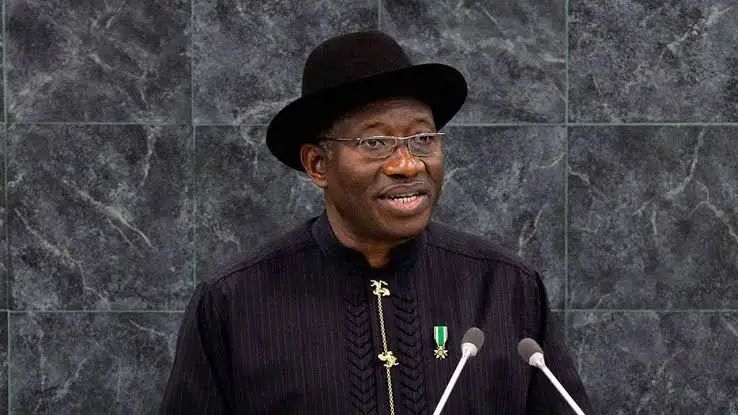
THE RETURN OF A STATESMAN:
A Critical Analysis of Civil Society Mobilization for a Goodluck Jonathan Presidential Run in 2027
By Amb. Valentine Opaluwa Ejeh, PhD
Religion, Conflict and Peace Scholar
ANU Community Peacebuilding & Environmental Sustainability Initiative (ACPESI), Abuja
Introduction
As Nigeria prepares for the 2027 general elections, an unexpected but growing political phenomenon has emerged: the renewed push by civil society organizations urging former President Goodluck Jonathan to re-enter the presidential contest. This resurgence is not merely a revival of old political loyalties but reflects a deeper sociopolitical yearning for moderation, stability, and statesmanship at a time of economic hardship, political polarization, and heightened national anxiety.
This movement has revived constitutional debates, including a court case filed by a Nigerian lawyer contending that Jonathan’s potential candidacy would violate the constitutional limit on presidential tenures. However, beyond the technicalities of tenure interpretation, the broader national discourse centers on Jonathan’s symbolic value: his democratic humility, his reputation for moderation, and his potential to ease zoning tensions while stabilizing Nigeria’s political climate.
This article analyzes these interconnected dimensions—constitutional, civic, political, and global. It also situates Jonathan’s possible return within the wider historical pattern of democratic nations recalling former leaders during moments of crisis, not for partisan reasons but for national cohesion.
1. The Constitutional Debate and the Doctrine of Necessity
The legal challenge to Jonathan’s eligibility rests on Section 137(1)(b) of the Nigerian Constitution, which prohibits any person from being sworn in more than twice as President of Nigeria. The central question is whether Jonathan’s first swearing-in in 2010 constitutes a “term” in the constitutional sense.
1.1 Background: Succession after Yar’Adua
Jonathan’s first ascension to the presidency occurred under extraordinary national circumstances. Following President Umaru Musa Yar’Adua’s prolonged incapacitation and subsequent death, Jonathan, then Vice President, was sworn in to complete the remainder of Yar’Adua’s tenure.
This transition occurred through the historic invocation of the Doctrine of Necessity by the National Assembly in February 2010, spearheaded by Senate President David Mark and supported by key voices including Senator Bala Mohammed.
Citations:
Ojo, E.O. (2014). The Doctrine of Necessity and Democratic Consolidation in Nigeria.
Suberu, R. (2015). Federalism and Political Crisis in Nigeria.
1.2 Legal Interpretations
Legal scholars widely hold that completing another person’s term does not constitute an original elective mandate and therefore does not count toward the two-term limit.
See:
Ibeanu, O. (2012). Electoral Governance and Term Limits in Africa.
Falana, F. (2019). Constitutional Law and the Nigerian Presidency.
This position was further implied in 2015 when Jonathan, as sitting President, contested against Muhammadu Buhari. If he had won, constitutional scholars agreed he would have legitimately completed his “first” elected term.
This precedent strongly suggests that a 2027 candidacy would not violate constitutional provisions unless the courts decide otherwise.
2. Why Civil Society Organizations Are Turning to Jonathan
Nigeria’s civil society has historically played a central role in democratic reform. Their renewed advocacy for Jonathan is driven by several distinct factors.
2.1 Jonathan’s Democratic Credentials
Jonathan remains the only Nigerian President to concede electoral defeat unequivocally and peacefully. His concession in 2015 has been widely cited as a benchmark of democratic maturity in Africa.
Citations:
Cheeseman, N. (2019). Democracy in Africa.
National Democratic Institute (NDI) Report, 2015.
2.2 Moderation and Temperament
Jonathan is frequently described by civil society leaders as an “unthreatening democrat” whose leadership style avoids authoritarian tendencies.
Citations:
Omotola, S. (2016). Leadership Style and Democratic Civilian Rule in Nigeria.
Campbell, J. (2018). Nigeria: What Everyone Needs to Know.
2.3 Non-sectionalism and Northern Trust
Jonathan’s policies—especially the Almajiri Education Initiative, are remembered positively in many northern states.
Citations:
UNICEF (2014). Evaluation of the Almajiri Education Initiative.
Ibrahim, J. (2017). Religion and Education Reform in Northern Nigeria.
2.4 His Role in Defusing Zoning Tensions
Zoning remains a delicate pillar of national stability. Jonathan is uniquely positioned to serve as a transitional consensus candidate who would likely serve only one term, allowing power rotation to be stabilized.
2.5 Public Dissatisfaction with Present Economic Hardships
Civil society groups argue that Jonathan represents an alternative leadership style characterized by empathy, socio-economic stability, and lower national tension.
3. International Implications of a Jonathan Return
Jonathan is widely perceived by the international community as a responsible democrat who respects rule of law and civil liberties. His return to politics would likely attract renewed global confidence.
Citations:
U.S. Department of State, Human Rights Report on Nigeria (2012–2015).
EU Election Observation Mission, Nigeria 2015 Final Report.
International partners often prefer leaders with predictable, conciliatory, and institution-respecting dispositions, traits Jonathan consistently demonstrated.
4. Global Precedents: Former Leaders Who Returned to Power
Jonathan’s potential return aligns with global democratic precedents where countries recalled past leaders during turbulent times.
4.1 Lula da Silva, Brazil
Returned to office in 2022 after previously leading the country (2003–2010), largely due to public dissatisfaction and desire for stability.
Citation: Hunter, W. (2023). Lula’s Second Coming.
4.2 Mahathir Mohamad — Malaysia
Returned at 92 to lead a reform coalition, demonstrating that political re-emergence can restore confidence during democratic crises.
Citation: Case, W. (2020). Malaysia’s Political Earthquake.
4.3 Alan García — Peru
Returned to the presidency after earlier tenure, illustrating that democratic societies reconsider former leaders during periods of instability.
Citation: Levitsky, S. (2010). Andean Democracy in Crisis.
4.4 Winston Churchill — United Kingdom
Voted out after WWII but returned to power when the political climate demanded his leadership.
Citation: Roberts, A. (2018). Churchill: Walking with Destiny.
4.5 Charles de Gaulle — France
Returned during the constitutional crisis to rebuild national stability and lead reform.
Citation: Hargreaves, A. (2010). Charles de Gaulle and the Rebirth of France.
These examples demonstrate a global pattern: nations often return to leaders who offer calm, unity, and legitimacy in uncertain times.
5. Jonathan’s Symbolic Value in Contemporary Nigeria
5.1 Stability in Uncertain Times
Jonathan’s political personality—unhurried, inclusive, and non-confrontational—stands in sharp contrast to Nigeria’s increasing polarization.
5.2 A Unifying National Figure
Jonathan rarely wielded state power against political opponents or the media. Civil society organizations regard this restraint as evidence of respect for institutions.
Citation: Freedom House (2015). Nigeria Country Report.
5.3 A Check Against Extremism
His inclusive leadership style acts as a counterweight to rising ethno religious divisions and political absolutism.
5.4 A Symbol of Peaceful Democratic Transition
His 2015 concession remains a reference point in African political science literature as a model of democratic civility.
6. Public Trust and Nostalgia for Stability
6.1 Trust Capital
Trust is Nigeria’s scarcest political commodity. Jonathan’s political brand is increasingly associated with nostalgia for economic calm and lower sociopolitical tension.
6.2 Governance Record
Despite well-known challenges, his administration expanded agriculture, enhanced electoral transparency, and maintained macroeconomic stability.
Citations:
Central Bank of Nigeria (CBN) Annual Economic Reports (2011–2014).
Jega, A. (2016). Electoral Reforms and Democratic Consolidation.
6.3 Respect for Institutions
Jonathan demonstrated unusual restraint for a president in a fragile democracy, allowing the judiciary, press, and INEC significant autonomy.
7. What Jonathan Represents in 2027
If Jonathan chooses to contest after wide consultations, his candidacy will likely emphasize:
national healing
stabilizing zoning and regional trust
re-centering governance on empathy and inclusion
rebuilding institutions
restoring international confidence
calming political tensions
offering a transitional, moderating presidency
His candidacy would not be about returning to the past but about applying seasoned statesmanship to guide Nigeria through democratic uncertainty.
Conclusion
The resurgence of civil society advocacy for Jonathan’s potential return reflects a complex national psychology: a longing for moderation, stability, trust, and democratic decency. While the constitutional debate awaits formal adjudication, political science literature and historical precedents offer a striking insight: nations often return to leaders who embody calm leadership in moments of uncertainty.
Globally, leaders such as Lula da Silva, Mahathir Mohamad, Churchill, and de Gaulle returned to power when their nations required unity and tolerable governance rather than ideological fervor. Nigeria’s current conditions mirror these pattern, economic hardship, political mistrust, social polarization, and institutional fragility.
Whether Jonathan contests or not, his symbolic re-emergence already influences Nigerian political imagination. He remains, for many Nigerians, the rare political figure who placed national peace above personal ambition, a statesman whose leadership style aligns with the values needed for Nigeria’s next democratic phase.
His potential candidacy represents more than a political contest: it embodies the possibility of restoring civility, stabilizing zoning, calming the national polity, and rebuilding trust between citizens and the state ahead of 2027.